Weekend Opinion: Standards Based Grading
Who are reports cards for?

I want to briefly talk about standards. The purpose of a standard is to set a common baseline, an agreed upon set of notions that we can all follow. Standards govern our lives - you’re reading this on a piece of technology with a thousand standards that govern it - from the USB power adapter (IEC 62680) to the wall power (NERC) to internet protocols to the written word you are reading. Some of these standards are governed by committees and some of them arise organically.
In Downtown Evanston is a research lab for UL - a company whose entire business model is to evaluate products against standards and certify them. Their logo gazes over Evanston, like an standards-based Eye of Sauron.
Standards are also a reflection of power. Look no further than the history section on the Wikipedia page for “Screw Threads.” If you want to operate a global military, it helps to have compatible parts in the far off operating theaters. It helps if the locals already produce a ¼-20 UNC-2A HEX HEAD CAP SCREW SAE J429 GRADE 5 ZINC PLATED for your naval vessel.
Letter Grades are a Standard
Most, if not all, Americans would agree this this is the standard of letter grades:
| Letter Grade | Percentage Range |
| ------------ | ---------------- |
| A            | 90–100           |
| B            | 80–89            |
| C            | 70–79            |
| D            | 60–69            |
| F            | < 60             |
It’s not just a technical thing, it’s deeply embedded into our culture - the grades have meaning in language outside of school. You’d describe something very good as “A+” or something bad as an “F”. It’s all over popular culture and is widely known, including to those who do not speak English as a first language.
The purpose of this standard is to provide obvious feedback on performance. For K-12 students, the consumer are the caretakers: the folks who ultimately make decisions regarding whether to get their student additional resources. The A-F system is known by everyone. That’s a feature, not a bug.
But if you don’t like the A-F system, you can also use the 4.0 standard, like many high schools and colleges, but you’re moving further away from something everyone knows.
The A-F Grading Standard is Evil?
Around 2018-2020 there were a lot of academic publications on the A-F grading system. In the District 65 Standardized Based Grading memo, you can see some of the citations and read the articles yourself.
Feldman, J. Beyond standards-based grading: Why equity must be part of grading reform
Guskey, T. Giving Retakes Their Best Chance to Improve Learning
Guskey, T. The Communication Challenge of Standards-Based Reporting
Jung, L. (with Guskey referenced in some versions) Grading Exceptional Learners
Marzano, R.J. & Heflebower, T. Grades That Show What Students Know
Muñoz, M. & Guskey, T. Standards-based grading and reporting will improve education
O’Connor, K., Jung, L., & Reeves, D. Gearing up for FAST grading and reporting
The Feldman one seems to be the most popular and he wrote a book on the subject, with 599 citations on Google Scholar. If you read his work you’ll see he views the A-F grading standard as the source of inequality, rooted in anti-immigrant bias (bolding is mine);
In the early 20th century, as techniques of mass production reshaped the U.S. economy and families from rural areas and immigrants flooded to cities, the need to educate large numbers of students led educators to apply the efficiencies of manufacturing to schools. So, just as manufacturing sought to increase production and maximize value, our schools were charged with sorting students into academic tracks that best reflected their supposedly fixed intellectual capacity and prepared them for their assumed life trajectories. In most cases, this sorting, facilitated by the introduction of the A-F scale, was used to justify and to provide unequal educational opportunities based on a student’s race or class.
He argues (without evidence) that this unequal system persists to this day;
By continuing to use century-old grading practices, we inadvertently perpetuate achievement and opportunity gaps, rewarding our most privileged students and punishing those who are not.
So what solution does Mr. Feldman offer? He argues that grades should be based solely on “summative assessments” - i.e. the test or final project that the end, which demonstrates mastery. Other things should be thrown out: attendance, behavior, tardiness, and notably, homework.1
What does he offer in terms of the mechanics of grading? Pretty much nothing. He points the reader to another paper who also don’t really offer up a replacement;
For example, if the leadership changes the grading scale from a percentage-based, 100-point scale to an integer-based, five-point scale, the computer-generated average percentage is eliminated, nudging teachers toward assessing proficiency.
So we’re kind of back at square one. The enemy is the A-F grading standard, but also the only equitable way to do grading is by taking a 100 point scale and reducing it to a 0-5 point system. I hope you can see where I’m going here.2
Feldman, a graduate of Stanford, NYU, and Harvard, founded the Crescendo Education Group. He is available to be a keynote speaker at your next event.
Standards-based Grading
Around 2020, in the early Horton years, District 65 started implementing standards based grading. You can read the whole history in this memo from 2024. It took almost five years of surveys, committees, meetings, and software modifications. You can see a sample 8th grade report card below or on these teacher training slides:
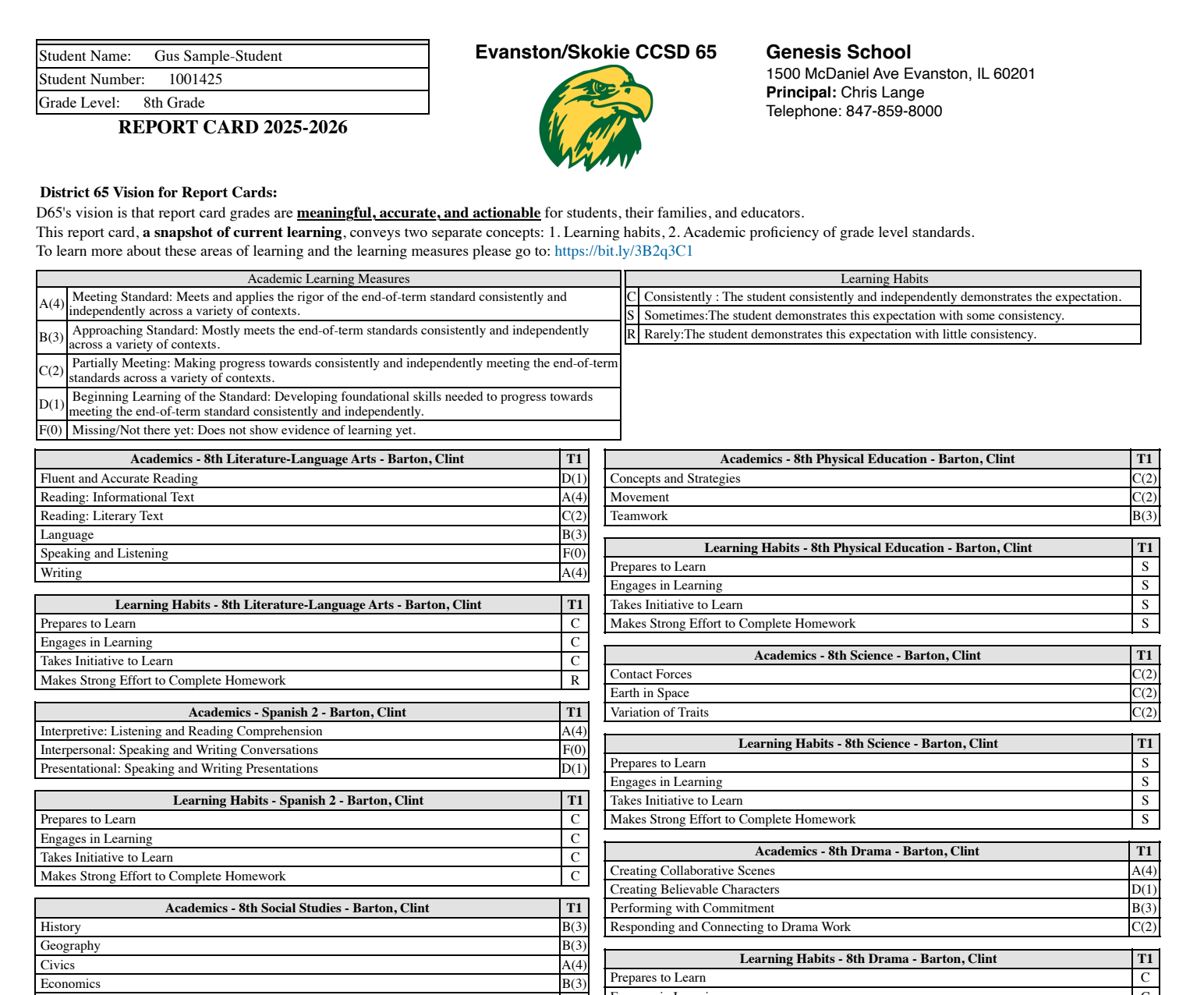
It’s confusing out of the gate - no longer do you get one grade per subject, you get one for each state academic standards topic. So in the case above for Spanish 2, the student got three grades:
Interpretive: Listening and Reading Comprehension A(4)
Interpersonal: Speaking and Writing Comprehension F(0)
Presentational: Speaking and Writing Presentations D(1)
This is fine .. but what if they don’t line up? How am I supposed to know whether the student is learning the content in its entirety? Maybe this works out for 8th grade physics but look at the fifth grade ELA categories:
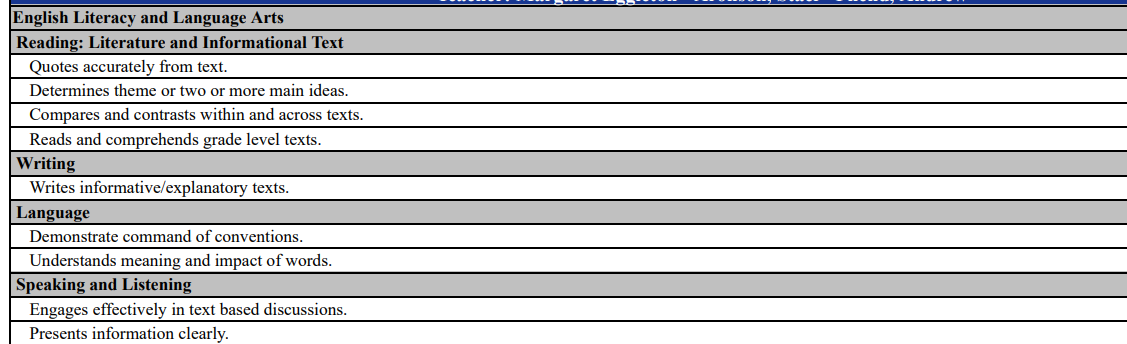
Am I supposed to average these? How do I reconcile them if they differ? What is actionable for me if my child has a low score in “Quotes accurately from text”? Am I supposed to lecture them about the importance of quoting from text?
This also presumes that I, the parent, know what all these topics mean. The District’s website doesn’t really provide much guidance on that, unless you go into the specific grade-level standards spreadsheet. Who exactly is this report card for?
In line with the research, they split “learning habits” from academic performance. That is itself fine (more information is better), but already added confusion since they collided into the A-F standard by using the letter C. This was an issue presented to the Board in the November meeting as an issue:
Resolve the dual meaning of the letter “C” (”Unsatisfactory” and “Consistently”) on the new report card to avoid confusion for families. We are considering using the first two letters for learning habits. For example, CO will be used to indicate “Consistently” and SO for “Sometimes”, and RA for “Rarely.”
This isn’t the first change. Middle school parents may be familiar with the total overhaul of moving from EX/ME/PR/BE/IE .. back to an A-F system, in order to align with high school and college.
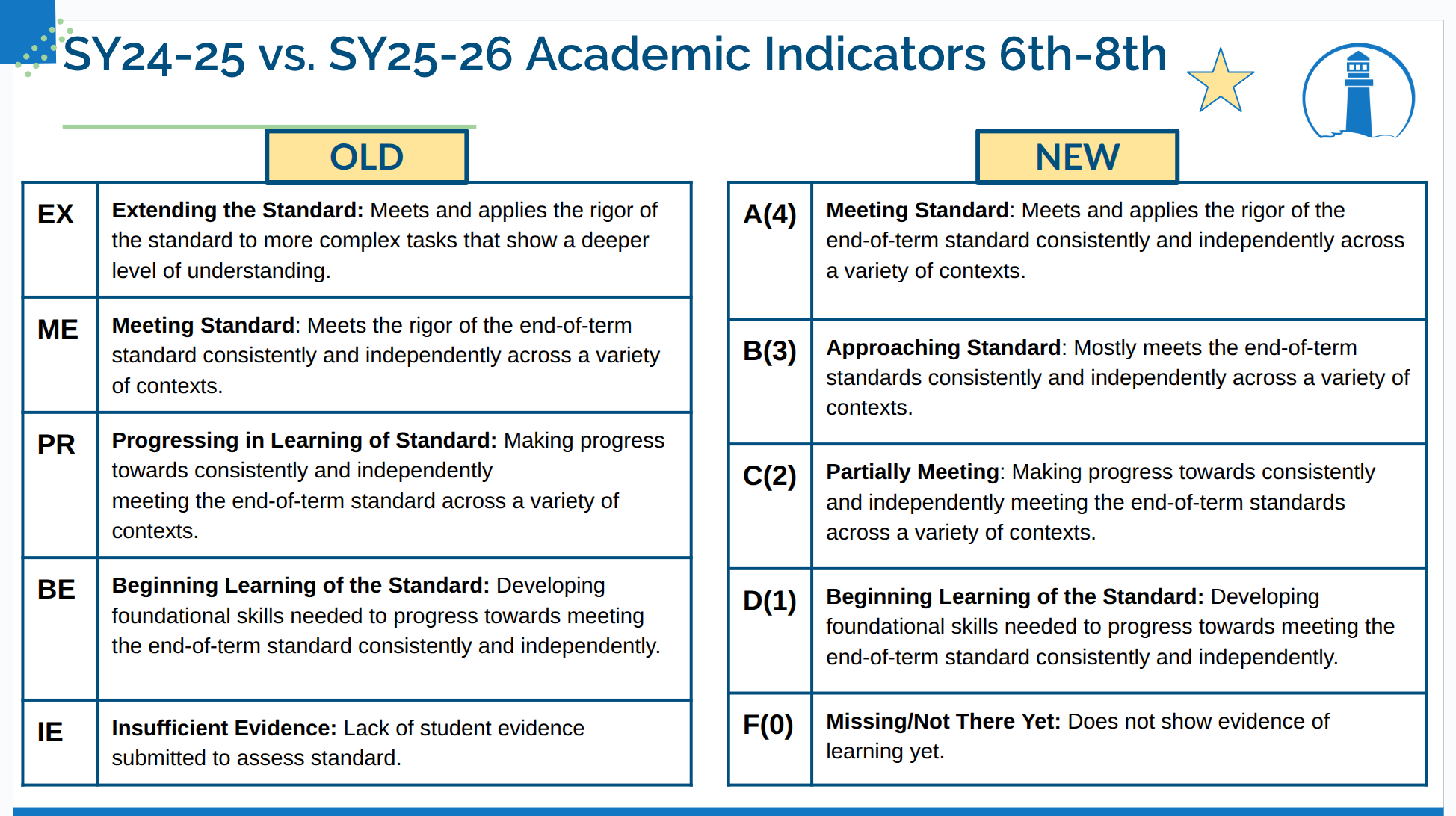
So now we’re back at the letter grade system? Are letter grades evil or not?
What makes these “standards based” is that they are linked to the state academic performance standards. For instance, you can see the fifth grade standards here. These are not standards anyone outside of education knows, or should know.
On Equity
For all the talk about how this system is more equitable, this is far less equitable than what we had before:
For a native speaker with an scientific academic background, who writes a blog on education (me), I can’t determine how my student is performing. I don’t know how to interpret these standards and grades.
For a non-native English speaker, how are they supposed to process this? I don’t even know where they would start. I guess maybe remove the password and put it in ChatGPT?
How is a student supposed to understand their performance? This is completely unreadable to students.
The document itself has tiny fonts, is a password protected PDF file, and is basically impossible to read on a phone. I had to print off a copy at home.
These report cards are inaccessible to anyone without a masters in education. Forget about me, think about working class parents who Doordash for living and work out of their phone. Or people who don’t speak English as a first language. Or parents who are not literate, but want a good education for their kids.
There is a standard that everyone knows - students, parents, non-english speakers, and even non-readers: the the A-F grading system. Using a grading standard that is known to everyone is the most equitable thing you can do, but we’ve ditched that for a system inclusive only to educational professionals.
Feldman’s whole complaint with the A-F grading system is that it rewards the most privileged students;
By continuing to use century-old grading practices, we inadvertently perpetuate achievement and opportunity gaps, rewarding our most privileged students and punishing those who are not.
This is no different, it just moves the ball on who the privileged are, but it’s still not the people they purport to help.
The District 65 system does include homework up to 15% of the grade. I don’t have a bone to pick with this system — I generally agree that if the students has mastery of the subject, the grade should reflect that more than say, their ability to do extra credit.
Big time “We’ve always been at war with Eastasia” vibes.